Is Our Flat Face a Sign of Self-Domestication?
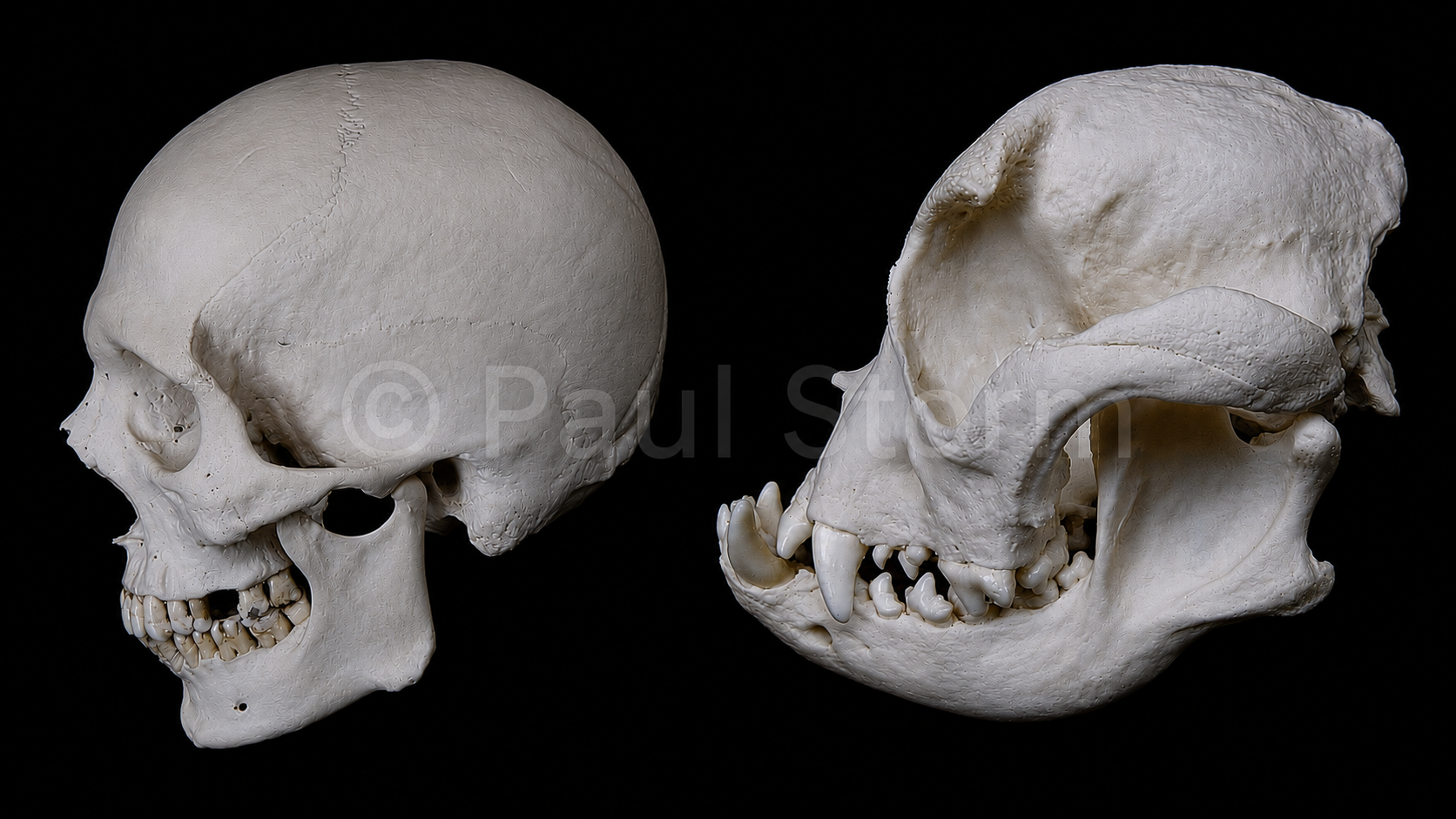
Humans have remarkably flat faces compared with the other living apes. As early as 1945, the anthropologist Franz Weidenreich noted in his book “Apes, Giants, and Man” striking similarities between the evolution of human skulls and the changes seen in domesticated dogs. In both cases, evolutionary change appeared to involve a relative enlargement of the braincase alongside a reduction in the size of the jaws and teeth. The bulldog represents an extreme example of facial flattening.
Interestingly, many domesticated dogs retain facial features that resemble those of juvenile wolves, including relatively flatter snouts. In other words, domesticated dogs appear to show paedomorphic traits — the retention of juvenile characteristics into adulthood. These observations raise the possibility that human evolution followed a broader biological pattern also seen in domesticated animals like dogs.
More recent research has explored what might drive such changes. Selection against reactive aggression has been proposed as a contributor to the development of paedomorphic traits. This raises an intriguing question: have humans domesticated themselves? The appeal of the self-domestication hypothesis lies in the fact that it concerns behavioural changes within human populations, allowing such traits to spread on a broad scale. However, studies of human skull evolution also reveal a more complex picture. Changes in skull shape and robustness may result from interacting genetic, environmental, and socio-cultural factors. Once migration and population replacement are also taken into account, identifying any single
explanation — including human self-domestication — as the main driver of the characteristic flatness of the human face becomes increasingly difficult.